Prediction Markets Are the New Wall Street: Polymarket vs Kalshi 2026 Guide
Polymarket and Kalshi have turned prediction markets into one of the fastest-growing corners of finance. Here is the legal framework, head-to-head comparison, retail-trader edge analysis, and the first insider trading case that just changed the rules.

Prediction markets - once a niche corner of online betting populated by political junkies and academic economists - have become one of the fastest-growing financial markets in the world. Polymarket's combined 24-hour trading volume now regularly exceeds $33 million. Kalshi, the CFTC-regulated U.S. competitor, has tripled monthly volume year over year. The first-ever U.S. insider trading case linked to a prediction market was charged on April 24, 2026 - a milestone that, however awkward, signals these markets are now real enough for regulators to police them like real financial markets.
Despite this growth, mainstream personal finance sites have almost entirely ignored prediction markets. That is the gap this guide fills. Here is what prediction markets actually are, how Polymarket and Kalshi differ, whether they are legal where you live, how to start trading, what edge (if any) retail traders can find, and the specific risks - including the new insider trading risk - that you need to understand before putting real money to work.
What are prediction markets - in plain language
A prediction market is an exchange where you trade contracts whose payoff depends on the outcome of a future event. The cleanest example: a contract on 'Will the Federal Reserve cut rates at its September 2026 meeting?' settles at $1 if Yes and $0 if No. If you buy the Yes contract at 35 cents, you make 65 cents per contract if the Fed cuts and lose 35 cents if it does not. The contract's price between zero and one is, by mathematical construction, the market's implied probability of the event occurring.
Prediction markets exist for U.S. elections, Federal Reserve rate decisions, sports outcomes, weather events, geopolitical milestones, crypto price targets, corporate earnings beats and misses, Supreme Court rulings, Oscar winners, and increasingly esoteric questions like 'Will OpenAI release GPT-6 before December 31?' The markets are continuously open, the prices update in real time, and settlement happens automatically based on a pre-defined oracle (an official source like the Fed, the AP, or a court filing).
Polymarket vs Kalshi - the head-to-head
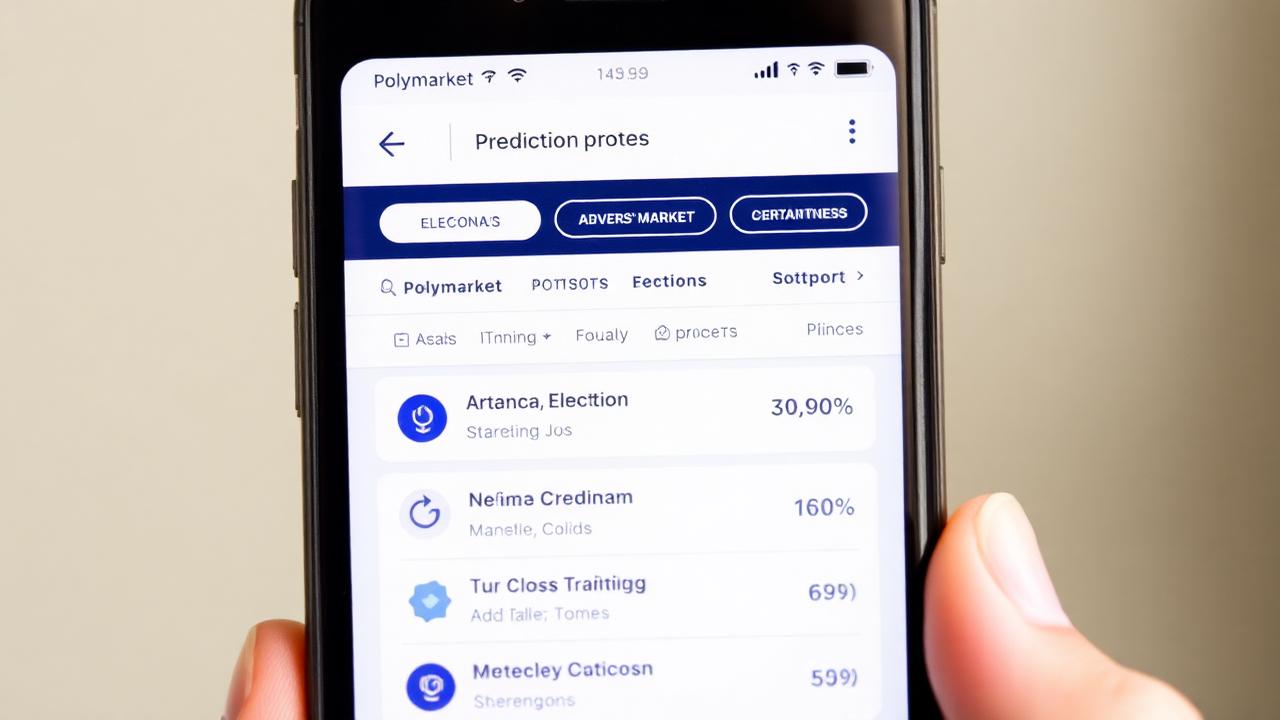
Polymarket and Kalshi are the two dominant platforms but they operate under fundamentally different regulatory frameworks. Polymarket is a crypto-native, offshore-domiciled exchange that runs on Polygon and settles in USDC. It is currently restricted from accepting U.S. user deposits under a 2022 CFTC enforcement action, though many U.S. users access it via VPN - a practice that is technically not legal but is rarely enforced against individual users. Polymarket carries higher liquidity and a wider range of markets including crypto and pop culture.
Kalshi is the CFTC-regulated U.S. designated contract market (DCM). It accepts U.S. residents directly, settles in USD, and reports user activity to the IRS. Kalshi has fewer markets, lower liquidity on most contracts, and a narrower range of approved event categories - but it is unambiguously legal and tax-compliant for U.S. users. For most U.S. retail readers, Kalshi is the appropriate starting point.
Are prediction markets legal in the U.S.?
Kalshi is fully legal in the U.S. as a CFTC-regulated DCM, with the exception of a small handful of state-level restrictions on specific contract categories (notably some sports and election-related markets in certain states). Polymarket is not legal for U.S. residents to deposit to or trade on directly under the 2022 CFTC enforcement order, although prediction-market regulation is evolving rapidly and the situation may change. Outside the U.S., Polymarket and Kalshi-equivalents operate in most jurisdictions, though specific country-level restrictions vary.
How to start trading prediction markets - the practical setup
For U.S. residents, the cleanest start is a Kalshi account funded via ACH from your bank. Sign up takes about 10 minutes including KYC verification. Minimum deposit is $1. Most markets trade in tick sizes of one cent and have no per-trade commission, though Kalshi takes a small spread and charges withdrawal fees on certain bank methods. For non-U.S. residents, Polymarket signup requires a self-custody crypto wallet (MetaMask, Coinbase Wallet, or Rabby) funded with USDC on Polygon.
Can retail traders actually make money on prediction markets?
The honest answer is: rarely, and only in specific circumstances. Like all liquid financial markets, prediction markets are reasonably efficient - the implied probability of a binary contract usually approximates the true probability within a few percentage points. The retail traders who consistently make money fall into one of three categories: (1) deep-domain experts on a specific topic where market participants are systematically wrong, (2) traders who exploit the structural premium on long-tail / low-probability contracts that overprice tail risk, and (3) traders who provide liquidity (limit orders) rather than take it (market orders).
The vast majority of retail prediction-market traders lose money - usually slowly, through cumulative spread costs and overconfident bets on narratives they like emotionally. Treat prediction markets like any other speculative trading: never put in more than you can comfortably lose, never trade on borrowed money (Kalshi does not offer it; Polymarket does on some markets and you should not use it), and track your performance honestly over at least a hundred trades before declaring yourself an edge.
The first prediction-market insider trading case
On April 24, 2026, the U.S. Department of Justice charged a U.S. Army soldier with insider trading for placing bets on Polymarket using non-public information about a planned military operation. This is the first criminal prosecution treating prediction-market positions as securities subject to insider trading law. The case has two implications. First, it confirms that prediction markets are now real enough and large enough to be policed like real financial markets. Second, it puts every trader on notice: trading on material non-public information is a federal crime regardless of which exchange you are using.
Prediction markets vs sports betting - how they actually differ
On the surface, prediction markets and sports betting look similar - both involve putting money on uncertain future outcomes with binary payoffs. The differences matter. Prediction markets are exchanges where you trade with other users, with the platform taking a small spread but not betting against you. Sportsbooks are dealers - they set the odds, take the other side of your bet, and profit from the structural edge built into the line. The mathematical edge against the bettor in a sportsbook is typically 4–10 percent. The edge against the trader in a well-functioning prediction market is the bid-ask spread, typically 1–3 percent.
The risks you actually need to understand
- Liquidity risk - many markets, especially long-tail ones, have wide bid-ask spreads that eat your edge.
- Settlement risk - disputes over whether an event 'really' happened. Both Polymarket and Kalshi have published dispute mechanisms, but resolutions can be slow.
- Regulatory risk - the legal status of prediction markets is evolving fast. A trade legal today may be technically illegal in your state next year.
- Tax complexity - Kalshi profits are taxed as ordinary income; Polymarket profits may be treated as capital gains or ordinary income depending on your jurisdiction.
- Behavioral risk - the gamification of these markets (real-time price updates, push notifications, social leaderboards) is engineered to drive trade frequency. Trade frequency is the enemy of net profitability.
Bottom line
Prediction markets are no longer a niche curiosity. They are a real, growing, increasingly regulated corner of the financial system that deserves attention from any investor interested in pricing real-world uncertainty. For most retail readers, the right starting point is Kalshi (if you are a U.S. resident) with a small allocation of speculative capital, a written set of trading rules, and the discipline to track results honestly. The biggest risk is not the technology or the legality - it is treating these markets like a casino instead of like the financial instrument they actually are.
Frequently Asked Questions
Are prediction markets legal in the United States?
Kalshi is fully legal as a CFTC-regulated designated contract market. Polymarket is not legal for U.S. residents to deposit to or trade on directly under the 2022 CFTC enforcement order, though enforcement against individual users is rare.
What is the difference between Polymarket and Kalshi?
Polymarket is crypto-native, settles in USDC on Polygon, has higher liquidity and broader markets, but is restricted for U.S. users. Kalshi is CFTC-regulated, settles in USD, accepts U.S. residents directly, and is tax-compliant - but has fewer markets and lower liquidity.
How do I start trading on Polymarket?
Outside the U.S.: connect a self-custody crypto wallet (MetaMask, Coinbase Wallet, Rabby) funded with USDC on Polygon. Inside the U.S.: Polymarket does not officially accept U.S. users - Kalshi is the legal alternative.
Can I make money on prediction markets?
Most retail traders lose money - usually through cumulative spread costs and overconfident bets. Profitable retail traders typically fall into three categories: deep-domain experts, structural-edge harvesters, and liquidity providers.
Are prediction markets the same as sports betting?
No. Prediction markets are exchanges where you trade with other users at small spreads (1–3 percent house edge). Sportsbooks are dealers betting against you at a much larger structural edge (4–10 percent).
How are prediction-market profits taxed?
Kalshi profits are taxed as ordinary income and Kalshi reports to the IRS. Polymarket profits in the U.S. are typically capital gains but the legal status is contested. Always consult a tax advisor.
What was the first prediction-market insider trading case?
On April 24, 2026, the U.S. DOJ charged a U.S. Army soldier with insider trading for using non-public information about a planned military operation to place positions on Polymarket. It was the first criminal prosecution treating prediction-market positions as securities-equivalent.
Sources
- Kalshi Official Exchange https://kalshi.com/
- Polymarket Official https://polymarket.com/
- CFTC Designated Contract Market List https://www.cftc.gov/
- U.S. DOJ Press Release on Prediction-Market Insider Trading https://www.justice.gov/
According to our editorial policy, every source link above was opened and checked against the claim it supports on .