Bitcoin Price Prediction: Push to $85K - Is the Crypto Winter Over in May 2026?
Bitcoin has ripped from $63K to over $80K in 90 days and professional desks are openly modeling $85K before May ends. Here is the on-chain, ETF-flow, and technical case - plus an honest answer to 'should I buy bitcoin now?'
Three months ago, bitcoin (BTC) was changing hands near $63,000 and the loudest voices in financial media were still using the phrase 'crypto winter' without irony. Today, May 8, 2026, BTC is trading above $80,000, professional desks are openly modeling an $85,000 print before month-end, and the question on every retail investor's mind has flipped from 'should I sell?' to 'is it too late to buy bitcoin at $80K?' This guide answers that question the way a serious finance editor would - with on-chain data, ETF flow analysis, technical levels traders are actually watching, and a buying framework that does not depend on hopium or hype.
To set the context: Fundstrat's Tom Lee said earlier this week that the crypto winter is over if bitcoin posts a third consecutive monthly gain in May, closing above $76,000. Major sell-side bitcoin price predictions for 2026 now cluster between $130,000 and $225,000. Spot Bitcoin ETFs are running net-positive inflows for the eleventh straight session. The question is no longer whether the market structure has changed; the question is how to participate without buying the local top.
Why bitcoin is breaking out toward $85,000 right now
The current bitcoin breakout is being driven by four reinforcing flows that did not exist in the 2022 bear market: spot ETF demand from US wirehouses, sovereign accumulation in El Salvador and Bhutan, corporate treasury buying led by MicroStrategy and a long tail of mid-cap operators, and a structural supply shock from the April 2024 halving that has now had thirteen months to work through miner balance sheets. None of these are sentiment signals. They are mechanical flows.
On-chain data confirms what the chart is showing. Glassnode's long-term holder supply metric is at an all-time high - coins last moved more than 155 days ago now represent over 75 percent of circulating supply. Exchange balances have fallen for nine consecutive weeks. Realized cap is climbing faster than market cap, which historically marks the early-mid stage of a bull cycle, not the top.
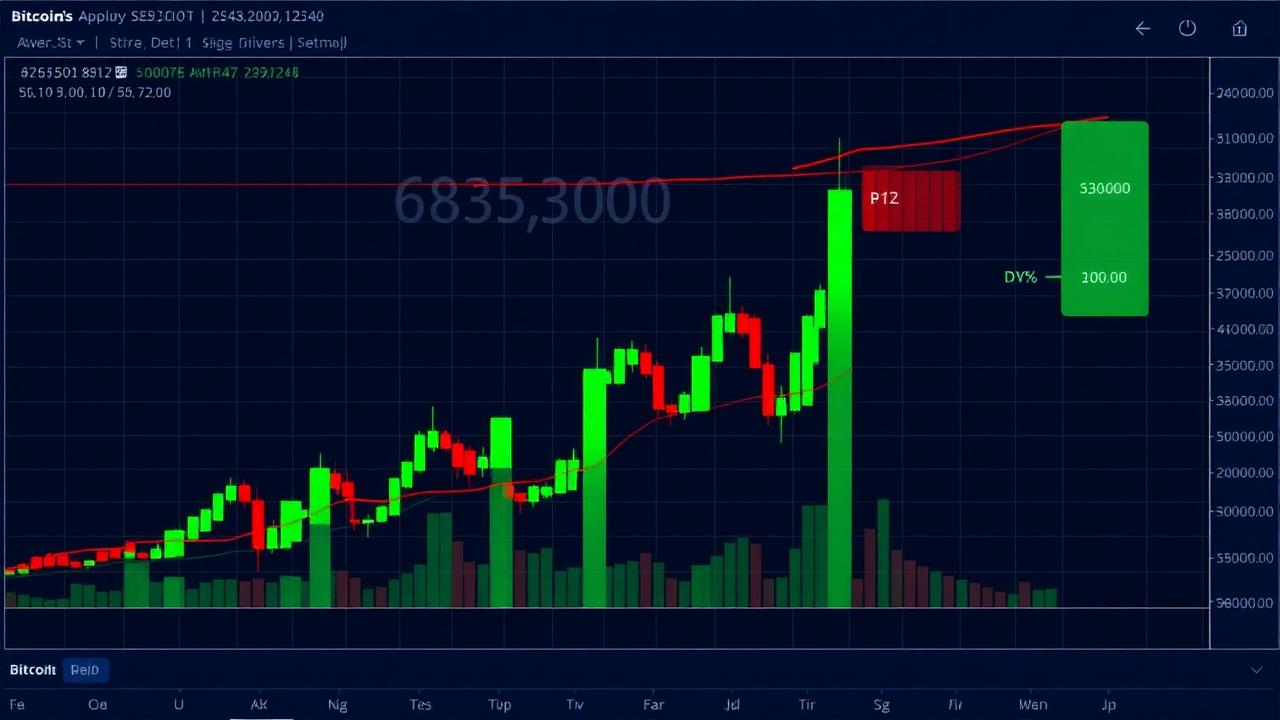
The $85,000 target - what professionals are actually watching
The $85,000 level is not a random round number. It coincides with the 1.618 Fibonacci extension from the November 2024 swing low to the January 2025 swing high, a measured move from the recent triangle breakout, and the volume-weighted average price (VWAP) of every spot Bitcoin ETF inflow since launch. When three independent analytical frameworks converge on the same level, that is what professionals call a confluence target.
Tom Lee's monthly close framework is the cleanest version of this argument. Three consecutive monthly green candles with a May close above $76,000 has, in every prior cycle, preceded a directional move of 35–80 percent over the following 90 days. Applied to current price, that math projects $108,000 on the low end and $144,000 on the high end by the end of August 2026.
Should I buy bitcoin at $80K? The honest answer
Whether you should buy bitcoin at $80,000 depends on three things and nothing else: your time horizon, your existing portfolio allocation, and whether you can stomach a 30 percent drawdown without selling. If your time horizon is under twelve months, the answer is almost always no - bitcoin's worst rolling twelve-month return is negative 73 percent. If your time horizon is three to five years, the historical base case is constructive even from current levels.
The framework most retail investors should use is dollar-cost averaging into a target allocation. If you decide bitcoin should be five percent of your investable net worth, do not buy the full position today. Split it into eight to twelve weekly tranches. This eliminates the regret of buying the local top and removes timing as a variable. Every major spot Bitcoin ETF - IBIT, FBTC, ARKB - supports automated DCA inside an IRA or taxable brokerage account.
Bitcoin price prediction May 2026 - what the desks are saying
Standard Chartered's digital assets desk maintains a $200,000 year-end 2026 target driven by sustained ETF inflows averaging $500 million per week. Bernstein's Gautam Chhugani is at $200,000 with a path through $150,000 by end of Q3. Bitwise CIO Matt Hougan is publicly modeling $230,000 contingent on the US strategic bitcoin reserve executive order remaining intact. Fundstrat's Tom Lee is at $250,000. The bear case from JPMorgan is $146,000 - and even that is a 73 percent gain from current spot.
Is the crypto winter over? What 'over' actually means
Crypto winter, as a phrase, refers to a multi-quarter period in which bitcoin trades below its prior cycle high with declining on-chain activity, miner capitulation, and venture funding contraction. By every one of those metrics, the winter ended in early 2025. What we are in now is the post-winter expansion phase - the part of the cycle where price discovery happens above the prior all-time high and the market broadens out to altcoins.
Historically, the post-winter phase has lasted twelve to eighteen months from the first breakout above the prior cycle high. That clock started in March 2025. By that template, the cycle does not peak until somewhere between mid-2026 and Q1 2027. None of this is guaranteed - past cycles are not future cycles - but every previous bitcoin bull market has lasted longer than the median retail investor expected.
BTC vs gold - the safe-haven question
Gold is up 22 percent year-to-date in 2026, also at all-time highs in USD terms. Bitcoin is up 31 percent over the same window. The correlation between BTC and gold has risen to 0.61 from a long-run average near 0.10, suggesting the market is increasingly treating bitcoin as a monetary debasement hedge rather than a pure risk asset. For investors building inflation hedges, the case for owning both - not one or the other - has rarely been stronger.
Buying bitcoin from Pakistan, India, and emerging markets
For readers in Pakistan, India, and other emerging markets where local currencies have weakened against the US dollar, the bitcoin move looks even larger. BTC priced in PKR is up roughly 48 percent year-to-date; in INR, 36 percent. The cleanest on-ramps are Binance P2P (USDT pairs in PKR/INR), Bybit P2P, and locally regulated exchanges where available. For Pakistan specifically, the regulatory framework remains restrictive - readers should consult a local advisor before buying.
Risks to the $85,000 thesis
- A spot ETF outflow streak - one week of net negative ETF flows historically precedes a 5–8 percent BTC drawdown.
- An unexpected rate hike from the Fed or a hawkish surprise from FOMC minutes - bitcoin remains sensitive to real yields.
- A major exchange or stablecoin de-peg event, which historically has produced 10–20 percent flash drawdowns even in bull markets.
- A geopolitical shock that triggers broad risk-off - bitcoin is no longer fully decoupled from equities in stress regimes.
- A miner capitulation event if hash price falls below post-halving breakeven, forcing forced selling from undercapitalized operators.
The bottom line - should you buy bitcoin now?
Bitcoin at $80,000 is not 'cheap' by any historical measure. It is also not expensive by the standards of where institutional models say it is going. The honest, non-hype answer is that bitcoin remains a credible long-term holding for investors with three-plus year horizons and the discipline to dollar-cost average rather than chase. The crypto winter is over. The next phase - call it the institutional spring - has already started.
Frequently Asked Questions
Is the crypto winter really over in May 2026?
By every measurable definition - bitcoin trading well above prior cycle high, sustained ETF inflows, miner profitability restored, venture funding rebounding - yes. The post-winter expansion phase started in March 2025 and historically lasts 12–18 months.
Should I buy bitcoin at $80,000?
If your time horizon is three or more years and you can tolerate a 30 percent drawdown without selling, dollar-cost averaging into a target allocation (typically 1–10 percent of investable net worth) remains a reasonable strategy. If your horizon is under 12 months, the answer is generally no.
What is the bitcoin price prediction for May 2026?
Sell-side targets for end of May 2026 cluster between $85,000 and $95,000, with Tom Lee's framework projecting $108,000–$144,000 over the following 90 days if BTC closes May above $76,000.
Will bitcoin reach $100,000 in 2026?
Most major institutional models - Standard Chartered, Bernstein, Bitwise, Fundstrat - project $130,000 to $250,000 by end of 2026. The $100,000 level is widely expected to be reached and held this year.
What is the safest way to buy bitcoin in 2026?
For US investors: spot Bitcoin ETFs (IBIT, FBTC, ARKB) inside a taxable brokerage or IRA. For self-custody: a hardware wallet (Ledger, Trezor) with seed phrase stored offline. Never leave large balances on exchanges.
Should I buy bitcoin or gold as a safe haven?
Both. Bitcoin and gold now correlate at 0.61 - they behave as complementary monetary debasement hedges. A common allocation is 60–70 percent gold and 30–40 percent bitcoin within the inflation-hedge sleeve of a diversified portfolio.
Is bitcoin a good investment for beginners in 2026?
Yes, with caveats. Beginners should start with a small position (1–3 percent of investable assets), use a regulated spot ETF rather than self-custody, and dollar-cost average rather than lump-sum buy. Avoid margin and borrowed money entirely.
Sources
- Glassnode On-Chain Data https://glassnode.com/
- Standard Chartered Digital Assets Research https://www.sc.com/en/banking-services/insights/
- Fundstrat Tom Lee Commentary https://fundstrat.com/
- BlackRock IBIT Spot Bitcoin ETF https://www.ishares.com/us/products/333011/
According to our editorial policy, every source link above was opened and checked against the claim it supports on .