UAE Plans AI-Run Government by 2027: What the Sovereign AI Race Means for American Investors and US Stocks
The United Arab Emirates announced a 2026 plan to run major government functions through artificial intelligence within two years, becoming the first country to formally bet that an AI-first state can outperform a human bureaucracy. The announcement is more than a Gulf headline. It is the clearest signal yet of the global state-run AI race that is quietly driving record contract awards to US companies including NVIDIA, Microsoft, Palantir, Cloudflare, and Snowflake. Here is what the UAE plan actually entails, who profits, the geopolitical risks, and exactly how American investors should think about positioning for the multi-year sovereign AI build-out.

The United Arab Emirates announced this week that it plans to operate major government functions through artificial intelligence within the next two years - the first national government to make state-run AI a formal operating model rather than an aspirational policy paper. Specifically, the UAE intends to use AI for legislative drafting, regulatory analysis, public-service delivery, court case management, customs and border operations, and large parts of tax administration. The announcement is being read in Washington, in Wall Street equity research, and in every major US AI company's strategy office as a clear shot in what is now the biggest emerging spending category in technology - national AI.
This article is written for American investors trying to figure out which US-listed stocks actually benefit, content creators in the AI space tracking the policy shift, and US policy-watchers trying to understand the export-control and national-security implications. We walk through what an 'AI-run government' actually means in practice, the global sovereign AI spend now in motion, the seven US-listed companies most directly tied to the build-out, the realistic risks and second-order effects, and how American long-term investors should position around it.
What 'AI-Run Government' Actually Means in Practice
The UAE plan is not robots replacing the prime minister. The realistic blueprint, based on the announced operational details and prior G42 (the UAE AI champion partnered with Microsoft) deployments, looks like this. Large language models trained on UAE law, regulation, court precedent, and policy archives generate first-draft legislation that human ministers approve. Public-service requests (visas, business registration, vehicle licensing, social benefits) get processed end-to-end by AI agents with humans only handling exceptions. Courts use AI to condense case files, draft routine orders, and suggest sentencing within human-judge oversight. Customs and ports use AI to auto-classify shipments, flag risk, and clear standard cargo without human review.
If executed competently, the result is a state that operates like a high-performance enterprise software company - faster, cheaper, more consistent, and with full audit trails. If executed poorly, the result is algorithmic governance that hides errors at scale and erodes due process. The UAE has chosen to be the lab. Every other G20 government is watching closely.

The Government-owned AI Race - Why Every Government Is Quietly Spending
Sovereign AI is the term for a country building, owning, and controlling AI infrastructure (data centers, chips, models, data) within its national borders rather than depending on US hyperscaler cloud regions in Northern Virginia, Oregon, or Ireland. The motivation is partly economic (capture the productivity gains domestically), partly national-security (do not depend on a foreign country for critical infrastructure), and partly cultural (train models on local language, legal tradition, and values rather than English-language American data).
The UAE leads the headlines, but the state AI capacity race is global. Saudi Arabia's Humain initiative (a $100 billion sovereign AI champion announced in 2024) is building competing infrastructure. India's IndiaAI mission has committed multi-year tens of billions to domestic compute. The UK, France, Germany, Japan, South Korea, Canada, Australia, and Brazil have all announced government-owned AI funds or programs in the past 24 months. Even mid-sized economies (Indonesia, Malaysia, Vietnam, Egypt, Nigeria) have started procurement processes. The cumulative addressable market over 2026-2030 is somewhere between $400 billion and $1.5 trillion depending on which research desk you ask.
Seven US-Listed Stocks Most Directly Exposed to State-run AI
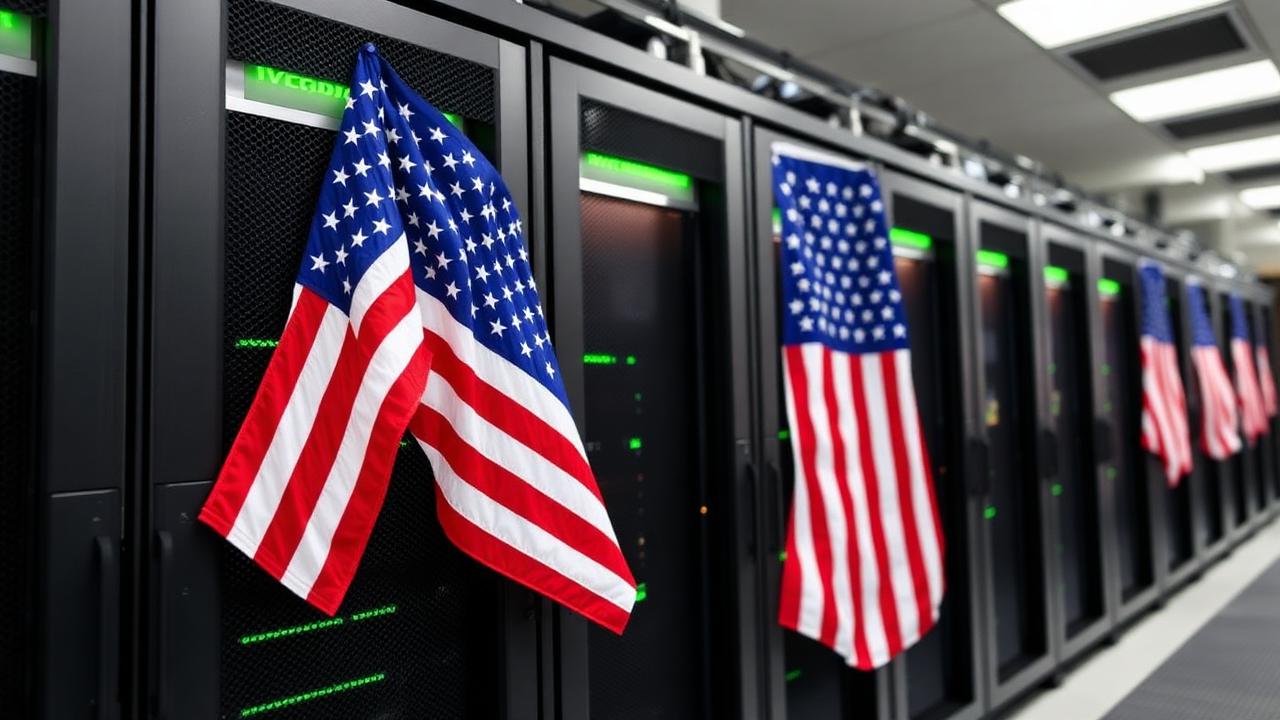
1. NVIDIA (NVDA) - The Indispensable Picks-and-Shovels Play
Every sovereign AI program needs Hopper-generation (H100, H200) and Blackwell-generation GPUs. NVIDIA's data-center revenue from state-run AI customers is now disclosed as a meaningful and growing line item, and the UAE's G42 partnership has been one of the largest non-US, non-China NVIDIA deployments. US export controls add complexity (specific chip variants are restricted to specific countries) but ultimately the binding constraint is supply, not demand.
2. Microsoft (MSFT) - The Sovereign Cloud Layer
Microsoft's strategic investment in G42 made it the de facto cloud provider of UAE government-owned AI. Microsoft Azure offers sovereign cloud regions with data residency, citizen-only operator access, and disconnected operation - the architecture that lets a country deploy GPT-class models without US-based personnel ever touching the data plane. The same playbook is repeating across multiple sovereign AI customers. Microsoft is the single most exposed Big Tech name to the national AI build-out.
3. Palantir Technologies (PLTR) - Government AI Software Specialist
Palantir's Foundry and AIP platforms are purpose-built for the use cases the UAE plan targets - integrating heterogeneous government data, deploying LLM agents on top, and providing audit trails that satisfy regulators. Palantir's existing US federal contracts give it the operational credibility to win analogous work internationally, and the company has been visibly expanding its Middle East and Asia presence.
4. Snowflake (SNOW) - The Government Data Layer
AI is only as good as the data it runs on. Snowflake's data cloud is increasingly the substrate that lets governments unify decades of fragmented agency data into a single AI-queryable layer. Snowflake's Cortex AI features and Iceberg-table support position it well for the data-platform leg of state AI capacity.
5. Cloudflare (NET) - The Zero-Trust Edge for Sovereign Networks
Sovereign AI deployments need network-layer security, edge inference, and zero-trust access control. Cloudflare's Workers AI and Zero Trust Network Access products are increasingly part of state-run AI architecture diagrams - especially for emerging-market governments that lack the in-house security operations to defend nation-state-attractive targets.
6. Equinix (EQIX) and Digital Realty (DLR) - Data Center Real Estate
Sovereign AI requires sovereign data centers - typically in-country, often near the seat of government. Hyperscale data center REITs Equinix and Digital Realty are quietly winning multi-decade leases for the build-out, and the operating-model of triple-net lease income from government-backed tenants is a defensive complement to the more volatile pure-play AI names.
7. Broadcom (AVGO) - Custom AI Chips and Networking
When government-owned AI customers want to reduce dependence on NVIDIA, the practical alternative is custom silicon designed by Broadcom for hyperscaler partners (Google TPU, Meta MTIA). Broadcom's networking silicon also dominates the high-bandwidth fabric inside every modern AI data center, making it a structural beneficiary regardless of which specific GPU or accelerator wins.
The US Export Control Wildcard
Every national AI deal involving a non-allied country runs through US export controls. The US government has created a tiered framework where Tier 1 allies (UK, Japan, Korea, Australia, Canada) get unrestricted access to top-end NVIDIA GPUs; Tier 2 partners (UAE, Saudi Arabia, India, Israel) get capped access subject to specific security undertakings; and Tier 3 countries (China, Russia, Iran, North Korea) get no access to top-end chips. The framework has been politically stable across both Biden and Trump administrations, but specific approvals can move quickly in either direction based on national-security developments. Investors should treat individual export licenses as non-binary risk factors, not catastrophic risks.
Realistic Risks and Second-Order Effects
- Algorithmic-governance failure - a high-profile AI mistake (a wrongful tax assessment, a biased visa denial at scale) could slow global sovereign AI adoption by years
- Geopolitical realignment - a future US administration could broaden or tighten export controls in a way that reshuffles the addressable market overnight
- Open-source AI displacing US commercial models - Llama, Mistral, DeepSeek, and Qwen open-weight models reduce the moat of US proprietary models but generally benefit the picks-and-shovels players (NVIDIA, hyperscale clouds, Snowflake, Palantir)
- Domestic political backlash within state-run AI countries - civil-society pushback against algorithmic government can delay or reverse adoption
- Energy and grid constraints - government-owned AI data centers consume gigawatts; many countries lack the grid capacity to support the announced spend, creating execution risk
How American Long-Term Investors Should Position
Sovereign AI is a multi-year compounder, not a quarterly trade. The right approach for a US long-term investor is exposure to the platform layer (NVIDIA, Microsoft, Broadcom), the application layer (Palantir, Snowflake), the security and edge layer (Cloudflare), and the real-estate layer (Equinix, Digital Realty), in proportions that match overall risk tolerance. None of these names are immune to broader AI cycle drawdowns, but the state AI capacity demand layer is structurally less correlated with US enterprise spend cycles - it follows national security priorities, not earnings season.
For passive investors, the simplest play is overweighting US large-cap technology and AI ETFs (XLK, IGV, AIQ, BOTZ) modestly relative to a market-cap baseline, with a small allocation to data-center REITs as a defensive ballast. For active investors, NVIDIA and Microsoft remain the highest-conviction sovereign-AI exposures with the deepest moats and the cleanest balance sheets. Palantir is the highest-beta single-name play - higher upside, higher volatility, less margin of safety.
The UAE announcement is the most explicit confirmation yet that national AI is a multi-decade, multi-trillion-dollar build-out. The boring answer for US investors is the picks-and-shovels - and boring usually wins compounding races.
The Bottom Line on Sovereign AI for US Investors
The UAE's plan to run government functions through AI by 2027 is the leading edge of a global state-run AI race that is now driving record contract awards to US-listed picks-and-shovels companies. NVIDIA, Microsoft, and Broadcom are the highest-conviction exposures; Palantir, Snowflake, and Cloudflare give application and security layer exposure; Equinix and Digital Realty provide defensive real-estate ballast. The risks are real - algorithmic governance failure, export-control swings, energy constraints, open-source displacement - but the demand curve is the most reliably upward-sloping spending category American technology investors have seen since the cloud build-out of 2010-2018. Position accordingly, with a multi-year horizon.
Frequently Asked Questions
What does it mean that the UAE will run its government with AI by 2027?
The UAE plans to use AI for legislative drafting, public-service delivery, court case management, customs and border operations, and tax administration within two years. Human ministers and judges remain in the loop as approvers, but routine bureaucratic work will be performed by AI agents with full audit trails. It is the first formal national-scale sovereign AI deployment in the world.
What is government-owned AI and why are governments spending so much on it?
National AI is when a country builds, owns, and controls AI infrastructure - data centers, chips, models, data - within its national borders rather than depending on US hyperscaler cloud regions abroad. Motivations include capturing economic productivity gains domestically, national-security independence, and training models on local language, legal tradition, and values. Estimated global sovereign AI spend over 2026-2030 is $400 billion to $1.5 trillion.
Which US stocks benefit most from the UAE AI government and global government-owned AI build-out?
Highest-conviction exposures: NVIDIA (NVDA, GPUs), Microsoft (MSFT, sovereign cloud + G42 partnership), Broadcom (AVGO, custom silicon and networking). Application and security layer: Palantir (PLTR), Snowflake (SNOW), Cloudflare (NET). Defensive real-estate ballast: Equinix (EQIX), Digital Realty (DLR).
How do US export controls affect state-run AI deals?
The US uses a tiered framework: Tier 1 allies (UK, Japan, Korea, Australia, Canada) get unrestricted access to top-end NVIDIA GPUs; Tier 2 partners (UAE, Saudi Arabia, India, Israel) get capped access with security undertakings; Tier 3 (China, Russia, Iran, North Korea) get no access. The framework has been stable across Biden and Trump administrations, but specific licenses can move based on national-security developments.
What are the biggest risks to sovereign AI as an investment theme?
Five main risks: (1) a high-profile algorithmic-governance failure that slows global adoption; (2) US export-control changes that reshuffle the addressable market; (3) open-source models (Llama, Mistral, DeepSeek) displacing US proprietary AI - though picks-and-shovels generally still benefit; (4) civil-society backlash within state AI capacity countries; (5) energy and grid constraints limiting actual deployment versus announced spend.
Should US retail investors buy NVIDIA or Microsoft for national AI exposure?
Both have the cleanest balance sheets, strongest moats, and most concrete sovereign AI revenue lines. NVIDIA captures the highest-margin layer (GPUs) but is more cyclical; Microsoft captures the recurring-revenue cloud and software layer with lower volatility. A diversified position in both, sized to overall risk tolerance, is the most defensible long-term state-run AI exposure for most US retail investors.
Sources
- NVIDIA Investor Relations https://investor.nvidia.com/
- Microsoft Investor Relations https://www.microsoft.com/en-us/Investor/
- US Bureau of Industry and Security (BIS) Export Controls https://www.bis.doc.gov/
- Stanford HAI AI Index Report https://hai.stanford.edu/ai-index
According to our editorial policy, every source link above was opened and checked against the claim it supports on .