Nvidia at $5 Trillion: Should You Buy, Hold or Sell NVDA Stock in 2026?
Nvidia just closed at a record high, pushing its market capitalization past the historic $5 trillion threshold for the second time. The chipmaker is now worth more than the entire German stock market and is the unchallenged king of the AI trade. But at this valuation, the question every investor faces is no longer whether to own NVDA - it's whether to buy more, hold what you have, or take profits before the next earnings print.
Nvidia just did it again. After briefly touching the $5 trillion market capitalization mark in October 2025, NVDA stock closed at a fresh record high this week, pushing the chipmaker decisively back above the historic $5 trillion threshold. Shares jumped over 4% in the session, dragging the entire semiconductor complex higher - Intel had its best single-day performance since 1987, and the iShares Semiconductor ETF is now up over 40% in April alone.
At $5 trillion, Nvidia is worth more than the entire German stock market, more than every European bank combined, and roughly equal to the GDP of Japan. It is the most valuable company in human history by a wide margin. The question facing every investor in April 2026 is no longer whether AI is real - that debate ended two years ago. The question is whether NVDA stock at this valuation is still a buy, a hold, or finally a sell.
How Nvidia Got to $5 Trillion (Again)
The current rally is being driven by three converging forces. First, Q1 2026 hyperscaler capex guidance from Microsoft, Meta, Alphabet, and Amazon collectively points to over $400 billion in AI infrastructure spending this year - a 35% increase over 2025 and far above prior expectations. Second, Nvidia's Blackwell platform is sold out through Q3 2026, and the next-generation Rubin architecture has already accumulated multi-billion-dollar pre-orders. Third, the China export situation has stabilized after Q4 2025 license clarifications, removing a major overhang.
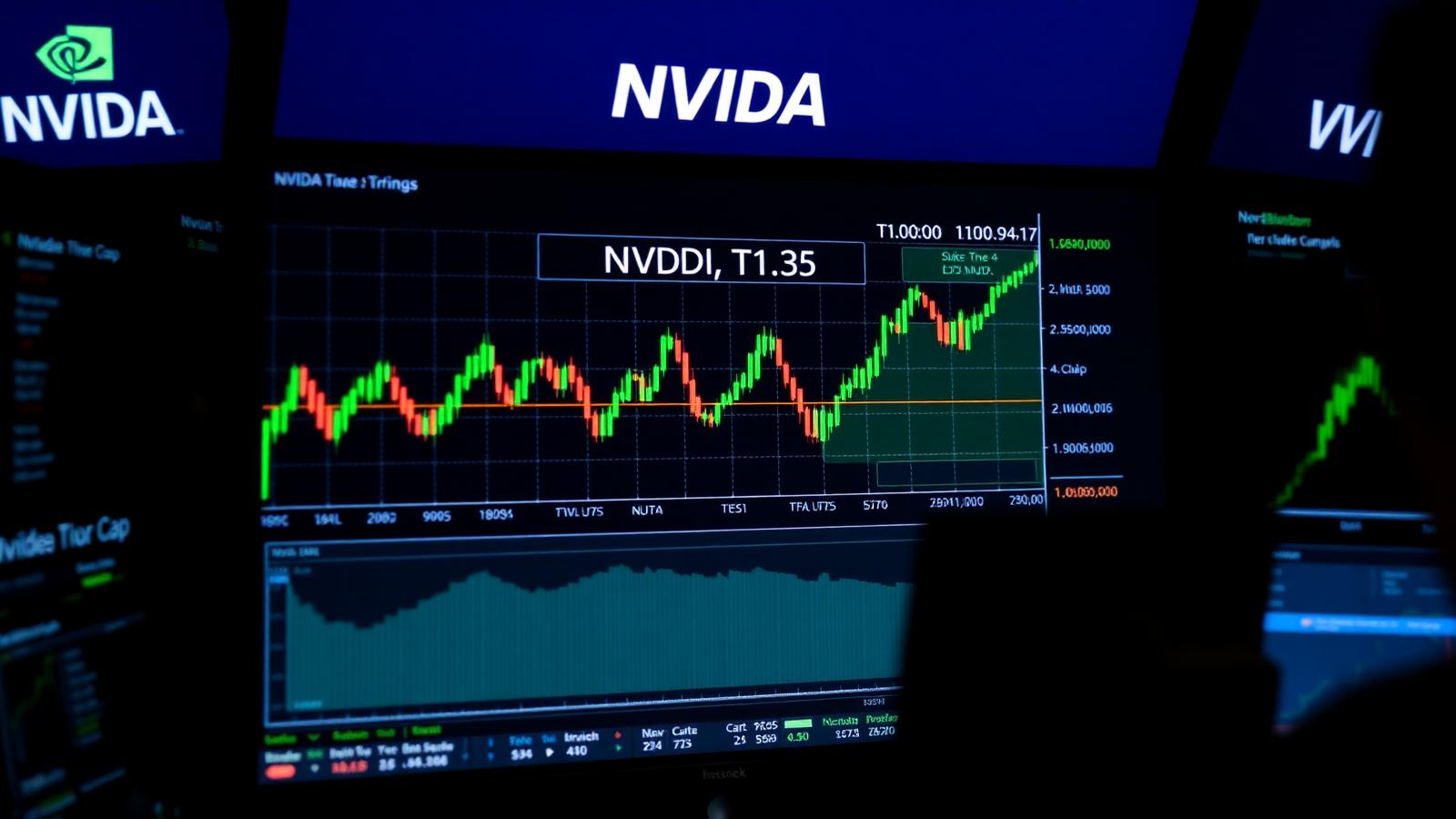
The Numbers Behind the $5 Trillion Cap
- Market capitalization: just above $5 trillion (record high)
- iShares Semiconductor ETF (SOXX): +40.4% month-to-date in April 2026
- NVDA stock: +19% in April alone, ~2% below all-time high
- Forward P/E: ~38x consensus 2026 earnings
- Trailing twelve-month revenue growth: still above 50% year-over-year
Why Demand Is Real - The Hyperscaler Capex Cycle
Skeptics have been calling for a 'capex digestion' phase since mid-2024. They have been wrong every quarter since. The four hyperscalers - Microsoft, Meta, Alphabet, Amazon - are not slowing down; they are accelerating. Combined 2026 capex guidance now exceeds $400 billion, the vast majority of which flows directly to Nvidia's GPU compute platform. Meta alone has guided to $60–65 billion in capex this year, more than triple its 2022 spending. Microsoft is committing $80+ billion. The buildout is not a bubble - it is a generational infrastructure race.

The Bull Case for NVDA Stock in 2026
If you are bullish, the math is straightforward. Nvidia's data center revenue is still growing well over 50% year-over-year. Blackwell is supply-constrained, not demand-constrained. The Rubin architecture (planned for late 2026) extends the technology lead by another two years. Sovereign AI deals - Saudi Arabia, UAE, India, Japan - are now multi-billion-dollar contracts. Inference workloads are scaling faster than training, expanding the addressable market beyond the original LLM training boom.
- Hyperscaler capex still accelerating (+35% YoY in 2026)
- Blackwell sold out through Q3 2026; Rubin pre-orders already exceed $10B
- Sovereign AI deals adding $20B+/year of incremental TAM
- Inference workloads scaling 2–3x faster than training
- Forward P/E of 38x is in line with 2017–2019 peak software-cycle multiples
The Bear Case for NVDA Stock in 2026
The bear case is not 'AI is fake.' The bear case is that priced-in expectations are now extreme. At a $5 trillion market cap and ~38x forward earnings, NVDA stock requires another 30%+ revenue growth in 2027 just to hold the multiple. Three risks could break the thesis: (1) custom silicon - Google's TPUs, Amazon's Trainium, Meta's MTIA - taking inference share, (2) a hyperscaler capex pause if AI ROI underwhelms, and (3) margin compression as competition and customer concentration bite.
What Could Trigger a Pullback
- Any single hyperscaler guides capex flat or down on next earnings call
- Custom-silicon market share data showing >15% inference penetration
- China export restriction reinstatement
- Gross margin compression below 73%
- A clear AI revenue disappointment from a major LLM company (OpenAI, Anthropic)
Buy, Hold, or Sell? - A Framework, Not a Forecast

If You Don't Own Nvidia
Buying a fresh full position at $5 trillion requires conviction the market cap doubles to $10T over 3–4 years. Most prudent advisors recommend dollar-cost averaging in over 6–12 months rather than a single lump-sum entry, or gaining diversified AI exposure through the SOXX or SMH semiconductor ETFs.
If You Already Own Nvidia (held since pre-2024)
Hold the core position; trim only enough to keep NVDA from exceeding 10–15% of total portfolio value. Outsized winners create concentration risk that can damage returns even if the underlying thesis is correct. Rebalance, do not exit.
If You're Sitting on a Large Profit
Consider a partial profit-take of 20–33% of the position, redeploying into adjacent AI beneficiaries (TSMC, ASML, Broadcom, hyperscaler customers themselves) or into defensive yield.
Comparison: Nvidia vs Other AI Beneficiaries in 2026
- TSMC (TSM): manufactures every Nvidia GPU; lower multiple, similar growth tailwind
- Broadcom (AVGO): custom AI silicon partner to Google + Meta; less concentration risk
- ASML: monopoly on EUV lithography machines required for advanced nodes
- Microsoft / Meta / Alphabet: capex spenders capturing AI revenue at the application layer
- iShares Semiconductor ETF (SOXX): diversified exposure if you want the trade without single-stock risk
Nvidia at $5 trillion is not the top of the AI cycle - it is what the top of the AI cycle would look like if it were already over. The data does not yet say it is over.
What to Watch Next: The 3 Catalysts That Decide NVDA's Next Move
Next week's hyperscaler earnings (Microsoft, Meta, Alphabet, Amazon) will dominate the tape - pay attention specifically to forward capex guidance, not just revenue beats. Nvidia's own May earnings will set the tone for the summer; watch data center revenue mix and gross margin commentary. Finally, any signal on Rubin pricing and pre-order economics will determine the 2027 setup.
Frequently Asked Questions
Is Nvidia stock a good buy at $5 trillion market cap?
Nvidia at $5 trillion is priced for 30%+ continued revenue growth in 2027. If you don't already own it, dollar-cost averaging over 6–12 months reduces timing risk. Most analysts rate NVDA as a hold or moderate buy at current levels.
What is Nvidia's stock price prediction for the rest of 2026?
Wall Street consensus 12-month price targets imply roughly 5–15% upside from current levels, but with wide dispersion. Bull case scenarios envision $6 trillion+ market cap by year-end if hyperscaler capex sustains and Rubin pre-orders accelerate.
Why did Nvidia hit $5 trillion market cap?
Nvidia crossed $5 trillion because of three converging forces: hyperscaler AI capex accelerating to over $400 billion in 2026, Blackwell GPU platform sold out through Q3 2026, and the Rubin next-generation architecture already accumulating multi-billion-dollar pre-orders.
Is Nvidia overvalued in 2026?
At ~38x forward earnings, Nvidia is valued in line with peak software-cycle multiples from 2017–2019, not at obvious bubble levels. The valuation is demanding but defensible if revenue growth stays above 30% and gross margins hold above 73%.
Should I sell my Nvidia stock now?
If NVDA exceeds 10–15% of your total portfolio, consider trimming to manage concentration risk - but rarely a full exit. Investors sitting on multi-bagger profits often take 20–33% off the table to lock in gains while keeping core exposure.
What are the best AI stocks besides Nvidia in 2026?
TSMC (TSM) manufactures every Nvidia GPU and trades at a lower multiple. Broadcom (AVGO) is the leading custom AI silicon partner to Google and Meta. ASML holds a monopoly on EUV lithography. For diversified exposure, the iShares Semiconductor ETF (SOXX) and the VanEck Semiconductor ETF (SMH).
Sources
- Nvidia Investor Relations https://investor.nvidia.com/
- CNBC - Nvidia $5 Trillion Coverage https://www.cnbc.com/2026/04/24/nvidia-stock-closes-at-record-pushing-market-cap-past-5-trillion.html
- Motley Fool - Nvidia at $5 Trillion: Buy, Sell, or Hold? https://www.fool.com/investing/2026/04/24/nvidia-at-5-trillion-buy-sell-or-hold/
- SEC EDGAR - NVDA Filings https://www.sec.gov/cgi-bin/browse-edgar?action=getcompany&CIK=0001045810
According to our editorial policy, every source link above was opened and checked against the claim it supports on .