How to Pay Off Credit Card Debt Fast in 2026: Avalanche, Snowball & Balance Transfer Guide
US credit card debt hit $1.21 trillion with average APRs at 21.9% - the highest ever recorded. This is the complete 2026 payoff playbook: avalanche vs snowball vs 0% APR balance transfer, when a consolidation loan wins, and a 90-day action plan that actually works.

American households are carrying $1.21 trillion of credit card debt as of the latest New York Fed Household Debt and Credit Report, and the average interest rate on a card balance is now 21.9% - the highest ever recorded. If you are one of the 47% of US cardholders carrying a balance month-to-month, the math is brutal: paying only the minimum on $8,000 of credit card debt at 22% APR takes over 30 years and costs more than $18,000 in interest. But it does not have to. This is a practical, no-fluff guide to paying off credit card debt fast in 2026 using the three strategies that actually work for real households: the avalanche method, the snowball method, and the 0% APR balance transfer.
Every strategy in this guide assumes you have already stopped adding new debt to the card you are trying to pay off, that you have a starter emergency fund of at least $1,000 in a separate account (see our best HYSA guide linked above), and that you have listed every debt you owe with its balance, interest rate, and minimum payment. If any of those three foundations are missing, fix them this week before you pick a payoff method - not next month.

How Credit Card Interest Actually Works
Before you pick a strategy, understand what you are fighting. Credit card interest compounds daily against your average daily balance. The 21.9% average APR translates to a periodic daily rate of roughly 0.060%. On an $8,000 balance, that adds about $4.80 in new interest every single day - roughly $145 per month - before you have paid a single new charge. Your minimum payment (typically 1-3% of balance plus interest) is calibrated by the lender to keep you paying for decades, because that is when they make the most money.
The 2009 CARD Act requires every credit card statement to display a 'Minimum Payment Warning' box showing exactly how long payoff would take at the minimum. Read that box on your next statement - the numbers are usually genuinely shocking, and they are also a very effective motivational tool.
Strategy 1: The Debt Avalanche Method
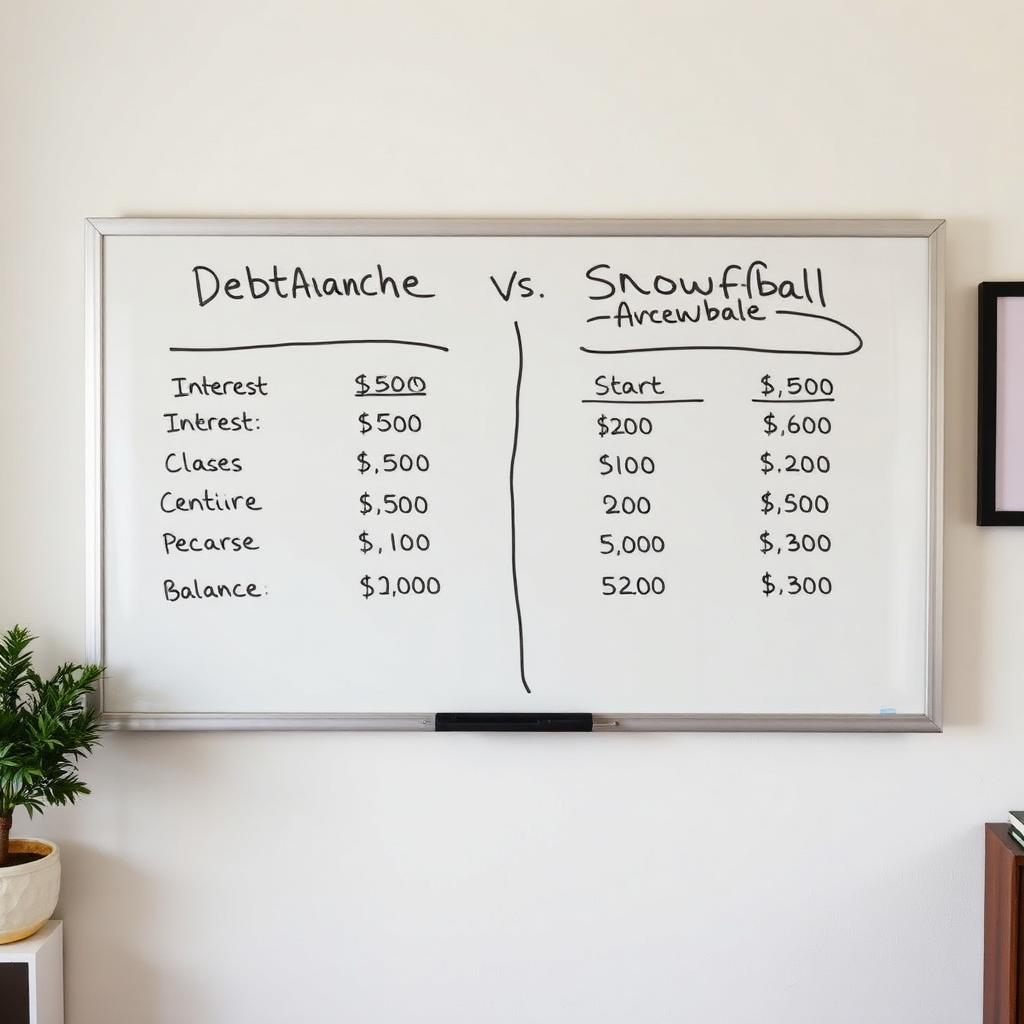
The debt avalanche is the mathematically optimal credit card debt payoff strategy. You make the minimum payment on every card except the one with the highest APR, and throw every extra dollar you can find at that highest-APR card. When it is paid off, you roll its entire payment amount onto the card with the next-highest APR, and so on down the list. This is called an 'avalanche' because the payment you can apply to each successive debt grows as prior debts are eliminated.
The avalanche is optimal because interest cost is a function of APR times balance times time. Attacking the highest-rate balance first minimizes total interest paid over the life of the payoff. For a household with four cards - say, a 28% APR store card, a 24% APR general-purpose card, a 19% APR travel card, and a 15% APR credit-union card - the avalanche saves several hundred to several thousand dollars vs paying them in a different order.
When to use the avalanche
- You are analytical and comfortable running the math
- The spread between your APRs is meaningful (5 percentage points or more)
- Your largest balance also carries your highest APR (very common)
- You do not need frequent 'wins' to stay motivated
Strategy 2: The Debt Snowball Method
The debt snowball, popularized by Dave Ramsey, ignores interest rate and instead attacks the smallest balance first regardless of APR. You make minimum payments on all cards except the one with the lowest balance, then throw everything extra at that smallest debt. When it is paid off, you roll the payment onto the next-smallest balance. It creates a series of quick 'wins' that maintains motivation, which is why controlled studies (notably the 2016 Northwestern Kellogg study) have found the snowball actually outperforms the avalanche for many real-world households despite being mathematically inferior.
The behavioral logic is real: paying off a $600 card in month two feels like a decisive victory, and that emotional reward buys you months of sustained payoff behavior. The avalanche, by contrast, may leave you slogging away at a $12,000 balance for eighteen months before the first card disappears. If you have tried and failed to pay off debt before, or if you know yourself well enough to admit that motivation matters more than math, the snowball is a legitimate choice - not a compromise.
When to use the snowball
- You have failed at debt payoff before and need momentum
- You have several small balances that can be knocked out quickly
- The APR spread between your cards is small (within 3-4 percentage points)
- You share a household budget and want visible wins to keep a partner engaged
Strategy 3: The 0% APR Balance Transfer
A balance transfer moves your existing credit card debt onto a new credit card that offers a 0% introductory APR for a promotional period - typically 15, 18, or 21 months in the current 2026 market. For the promotional period, 100% of every payment you make goes to principal instead of being eaten by 22% interest. This is by far the most powerful of the three strategies for savers with credit scores of roughly 690 and above who can qualify for a top-tier offer.

The math and the trade-off
Balance transfer cards charge a one-time transfer fee, typically 3%-5% of the balance moved. On a $10,000 transfer at a 3% fee, you pay $300 upfront but save roughly $2,000 in interest over 15 months at 22% APR. The math almost always favors the transfer if you can actually pay off the balance within the promotional window. If you cannot - if you are transferring debt only to keep making minimum payments - the deferred interest kicks in at the end of the promo period at a rate typically higher than your original card, and you have gained nothing except a hard credit inquiry.
Top 0% balance transfer cards to research in 2026
- Wells Fargo Reflect Card - 21 months 0% intro APR on balance transfers, 3% transfer fee for the first 120 days then 5%
- Citi Double Cash Card - 18 months 0% intro APR on balance transfers, 3% transfer fee
- Chase Slate Edge - 18 months 0% intro APR, 3% transfer fee
- US Bank Visa Platinum - 21 months 0% intro APR on balance transfers, 3% transfer fee
- Discover it Balance Transfer - 18 months 0% intro APR, 3% transfer fee, potential 5% cashback categories
Rules to make a balance transfer actually work
- Divide your transferred balance by the number of promo months and set an automatic payment for that amount - do not rely on willpower
- Do not use the new card for purchases (purchases usually accrue interest immediately even during the balance-transfer promo)
- Do not close the old card once the balance is transferred - it may hurt your credit utilization and average account age
- Have a written plan for the balance that will remain after the promo expires (a second balance transfer, a personal loan, or accelerated payoff)
Alternative: Debt Consolidation Personal Loan
If your credit score is too low for a 0% balance transfer card (typically below 680) or the balance you need to move exceeds what any single card will approve you for, a fixed-rate debt consolidation personal loan is often the next-best move. In May 2026, personal loan rates from top lenders like SoFi, LightStream, Discover Personal Loans, and Marcus by Goldman Sachs range from about 8.9% to 24% APR based on credit tier. Even the high end of that range is comfortably below the 22% average credit card APR.
Personal loans have three structural advantages over credit card debt: a fixed monthly payment, a fixed payoff date (typically 24-84 months), and a fixed interest rate that cannot rise. The trade-off is that they are installment loans, not revolving credit, so you cannot re-borrow against them if a genuine emergency hits during payoff. Keep your emergency fund intact even if it slows the payoff by a few months.

What About Debt Settlement, Debt Management Plans, and Bankruptcy?
These are options of last resort. Debt settlement (paying a lender less than you owe in exchange for accepting settlement) trashes your credit for seven years, generates taxable phantom income on the forgiven portion, and is almost always accompanied by aggressive collections calls during the settlement process. Debt Management Plans (DMPs) offered by nonprofit credit counseling agencies (NFCC-affiliated) can reduce your effective rate to 6%-10% and consolidate payments into one monthly amount - a legitimate option for households whose income cannot support snowball or avalanche payoff at current APRs.
Chapter 7 or Chapter 13 bankruptcy is a serious tool that exists for a reason - it wipes out unsecured credit card debt in most cases and gives an overwhelmed household a fresh start. It stays on your credit report for 7-10 years and requires a means test, but for households with more than $30,000 of unsecured debt and no realistic path to repayment within five years, filing is often financially and emotionally the right call. Consult a bankruptcy attorney (many offer free initial consultations) rather than a for-profit debt settlement company.
Your 90-Day Debt Payoff Action Plan
Days 1-7: Assess and stabilize
- Pull your credit reports free at AnnualCreditReport.com and list every debt with balance, APR, minimum payment, and due date
- Confirm you have at least $1,000 in a separate savings account before starting aggressive payoff
- Cut up or freeze (literally, in ice) any card you are trying to pay off - use a debit card for daily spending
- Call each card issuer and ask for a lower APR - a scripted request works about 30% of the time and takes 15 minutes
Days 8-30: Choose your strategy and set up automation
- Pick avalanche, snowball, or balance transfer based on your APR spread, credit score, and behavioral profile
- Set up automatic minimum payments on every card so nothing goes past due during the payoff
- Set an additional automatic 'target' payment for whichever card you are attacking first
- If pursuing balance transfer, apply for the card and complete the transfer within 60 days (most cards require it)
Days 31-90: Execute and cut expenses
- Review your last 90 days of checking-account transactions and identify $100-$500 of monthly recurring expenses to cut permanently
- Redirect every dollar of expense cuts, tax refunds, bonuses, and side income to the target card
- Track balances weekly - the visual momentum of a falling balance is a legitimate motivator
- At the end of month 3, reassess: if progress is meaningful, continue; if not, consider a credit counseling consultation
What to Do After the Last Card Hits Zero
The single most important financial move you make in an entire debt payoff is what you do the day after the last card is paid off. The freed-up monthly payment - often $500-$1,500 for a household that just paid off five figures of debt - either gets spent on lifestyle inflation or gets redirected into wealth-building. Redirect it. Send the same monthly amount, automatically, to your emergency fund (until it reaches 3-6 months of expenses), then to a Roth IRA up to the annual limit, then to your 401k up to the employer match, then to a taxable brokerage account holding a low-cost index fund.
This is the moment that separates households who briefly escape credit card debt from households who never carry it again. If you need a roadmap for the retirement piece, see our full Roth IRA vs 401k guide - it is the natural next step after the debt is gone. If credit card debt is only part of a broader student loan or medical debt burden, our student loan wage garnishment guide covers the federal loan side.
Bottom Line
There is no single 'best' credit card debt payoff strategy - there is the best one for your APRs, your balances, your credit score, and your behavioral profile. The avalanche saves the most interest. The snowball keeps you motivated. The 0% balance transfer wins for high-credit-score borrowers with a real payoff plan. A consolidation loan wins when the balance is too big for a card or the credit score is too low. What matters is picking one and executing it for at least 90 days without changing course.
Twelve months from now the average American household with credit card debt will still be paying 22% interest, still making minimum payments, and still be no closer to the exit. Households that pick a strategy this week, automate it, and cut $200-$500 of monthly recurring expenses to accelerate payoff will be a year closer to the wealth-building phase. This guide gives you the tools. The first move is yours to make.
Frequently Asked Questions
Should I pay off credit cards or save first?
Save $1,000 in a starter emergency fund first, then attack credit card debt aggressively while continuing to capture any 401(k) employer match. Once the cards are paid off, redirect the freed-up payment to building a full 3-6 month emergency fund and then Roth IRA / 401(k) contributions.
Does closing a paid-off credit card hurt my credit?
It can. Closing a card reduces your total available credit which raises your credit utilization ratio (a 30% factor in FICO scoring), and reduces your average account age. Keep old cards open with a small recurring auto-payment on them (e.g. a streaming subscription) unless the card has an annual fee that is not worth paying.
How does a balance transfer affect my credit score?
You will see a temporary dip of 5-15 points from the hard inquiry when you apply. Long-term, a balance transfer usually helps your score by lowering utilization on the original card. Do not close the original card after the transfer - keeping it open helps your utilization and average age of accounts.
Is a personal loan better than a balance transfer?
A 0% APR balance transfer is better if your credit score qualifies and you can realistically pay off the balance within the 15-21 month promo window. A personal loan is better for larger balances, lower credit scores, or when you want the discipline of a fixed monthly payment and a fixed payoff date.
How long does it take to pay off $10,000 of credit card debt?
At only the minimum payment on a 22% APR card, roughly 30+ years and over $18,000 in interest. Aggressive payoff of $500/month at 22% APR gets you there in about 26 months. A 0% APR balance transfer with $500/month payments finishes in 20 months with zero interest.
Can I negotiate a lower APR with my credit card company?
Yes. Call the number on the back of the card, ask to speak with retention, and specifically request an APR reduction citing your on-time payment history and competing 0% offers you have received. Success rate is roughly 30% and takes 15 minutes. Even a 3-percentage-point APR reduction on $10,000 saves $300/year.
Sources
- New York Fed Household Debt and Credit Report https://www.newyorkfed.org/microeconomics/hhdc.html
- CFPB Credit Card Market Report https://www.consumerfinance.gov/data-research/research-reports/consumer-credit-card-market-report/
- Federal Reserve G.19 Consumer Credit https://www.federalreserve.gov/releases/g19/
- NFCC (National Foundation for Credit Counseling) https://www.nfcc.org/
According to our editorial policy, every source link above was opened and checked against the claim it supports on .